V
While the Smiths were long-time Glaswegians, the city's rapid
growth was more than just a product of the birth rate. Glasgow
became both a haven and a point for embarkation. Following the
Battle of Culloden, the power of the Highland clans was crushed.
Besides the legislative penalties declared by the crown, many
land owners took advantage of the situation by clearing the lands
of its people. "The clearances", as they were called, had the effect
of reclaiming the homelands of the Highlanders for the purpose of
sheep farming.
The dispersal began in 1746 with the Disarming Act, but continued long after the 1782 repeal of the Act of Parliament that prohibited the wearing of Highland dress. Ironically, the Caledonian Canal which had been built by the labour of Highland muscle, became the waterway that took people from their lands. Many came to Glasgow to board ships to the Americas. Others stayed, and swelled the population of the growing industrial giant. The influx reached its peak in the 1840s and early 1850s, particularly in the aftermath of the great potato blight of 1846.
One such Highlander was Hugh McPhee. Who quite likely came from the Argyllshire on the West Coast. When he arrived in Glasgow is not known, but once there, he married Elizabeth May. At the time of their marriage, he was counted as a member of Glasgow's labour force, but his ability enabled him to become a journeyman boilermaker. The marriage took place on 6 June 1851, and was conducted by Dr. MacLeod of the Barony Church. Witnesses at the wedding were friends of the groom who bore highland names, William MacPherson and Lachlan McLachlan. Incidently, Norman MacLeod, the minister of record, became something of a Glasgow institution, and his two volume memoirs are contained in the Mitchell Library.
The middle of the ninteenth century heard other accents in Glasgow. During the Hungry Forties many fled the potato famine in Ireland and Ulster. At its peak, the influx from across the Irish Sea numbered a thousand people a week to Glasgow. Among those fleeing was Alexander Jamieson and his wife Nancy Cochrane. With them was their son, William John, who was born near Belfast in 1849.
The plight of the Jamiesons could be multiplied by the thousands as the labour force grew. Irish workers scrambled to find work in a society that was prejudiced against them. In many ways, however, the Jamiesons were fortunate, for they were the Protestant decendants of lowland Scots who were sent to the Ulster Plantation in the time of King James in an effort to sever the communication between Ireland and the Highland Catholics. Being devout Protestants and having a Scottish surname became the advantages that helped this family from County Down blend into the Glasgow scene. Nancy shed her Irish sounding given name for the more common Scottish form, Agnes. ("Nancy" means "My Agnes".)
Alexander became a chemist's labourer, but his son, William John Jamieson, became part of the skilled labour force by achieving the rank of journeyman boiler maker. This was also the vocation of his bride's father, for in 1872 he married the girl down the street, Flora McPhee, daughter of Hugh McPhee. They lived in Hutchesontown in the district of Govan church. With his bride came his mother-in-law who was a widow, and lived with them until she died at the age of 95 after being struck by a bicycle.
Govan on the south bank of the Clyde had become a center of
the ship building industry in the first half of the ninteenth
century. It was in these shipyards that a boiler maker could
find secure employment, but industrial Glasgow presented other
opportunities. The railway workshops also needed the boiler
maker's skills in the locomotive industry, and the Jamiesons took
up residence on Shepherd Street in Springburn. It was in this
burgh of Glasgow that the Smiths and the Jamiesons first met, and
two Glaswegian families, one old and one new, were introduced to
each other. Actually, the families had very little to do with
the match-making process. As in most ages, young people have a
way of finding each other, and the story is told of a young lad
meeting a young lass in the bakery shop were she worked. The
young man was Adam Lillie Smith who was an avid cyclist and
football (soccer) player. The young woman was Elizabeth May
Jamieson whose mother had been a confectioner's worker before
her.
No one knows how long the romance took to blossom, but Adam probably stopped frequently at the shop, and lingered to talk with the redhead behind the counter. He was not a tall man, but he had a toughness that belied his stature. In 1887 his football team defeated Edinburgh in the rivalry between Glasgow and the Capital. In later years, when he managed the labour force in Youngstown steel mills, he had a reputation for toughness that commanded loyalty and respect. A man of action with a temper to match, his management style belonged to an age long past. Yet, he was putty in the hands of his Elizabeth. Descended from staunch Covenanters, she had Adam attending the kirk and singing the metric Psalms. Under the watchful eye of her mother, and with strict moral upbringing, the two had little room to stray. This pattern of life never left Elizabeth who always held a tight rein on her family. Even after their children were born, Adam would strike agreements with the children as to why they were late getting home when they had actually stopped to watch a ball game. Personally, I remember her as a benevolent authority. While she did present me with a King James version of the Book of Proverbs to be my life's guide, she also filled me with white tea and cookies.
The wedding did not take place in Scotland, however. Adam followed his two older brothers to Pittsburgh, and after arranging for housing and employment, he sent boat fare to his bride-to-be. It was a nervous mother who saw her oldest daughter set off for America. She only gave her consent on the promise that Adam and Elizabeth would be married on the very day that they met in Pittsburgh. She would brook no delay when it came to her daughter's honor. They said their good-byes as Elizabeth boarded the liner with her luggage and a carefully wrapped wedding gown.
She entered the country through Ellis Island, and took a train to Pittsburgh. When the train pulled in to the station, it was raining, but they kept their promise, and were married that very day, 31 October 1895. In true Scottish fashion, however, Elizabeth did not wear her fancy gown for fear that the rain would ruin the fabric.
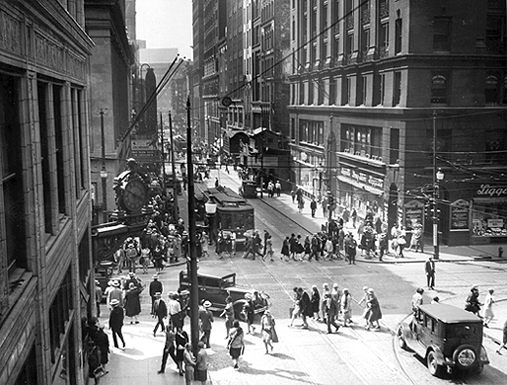
This might be the end to the story with regard to the family's connection with Glasgow, but there were adventures yet to come. After the birth of their first child, Flora, the young family longed for home. "I'd like to go down the Clyde one more time," said Adam, and that sentiment was reason enough to move back. In Scotland, their second child, Helen, was born. The realities of Scotland had not changed, however, and employment opportunities were limited. After trying to make a living selling insurance, Adam asked: "You know where I'd like to be?"He answered his own question: "Under the big clock on Smithfield Street." This time, they came to the States to stay, and returning to the city of Pittsburgh.
Adam Lillie Smith and Elizabeth May Jamieson
